
Following a Tracy Street Directory
The cleanest by-address search follows one parcel from map to record. Use the exact number and the legal street name in the San Joaquin District Viewer. Open Details, note the APN and situs, then carry that APN to the assessment map, recorder, tax, and permit channels. The map may show a physical parcel and its districts, but it does not expose the owner or occupant on the public screen.
That order matters. A tax mailing address can belong to an owner somewhere else. A permit applicant can be a contractor. A deed party can be a seller, lender, trust, or buyer. A voter product can include an eligible registered voter, but it is restricted and never a full list of adults at an address.
- Enter the street number and legal street name, leaving off direction and Street, Road, or Drive.
- Record the APN, situs, ZIP, post office, city-limit, and sphere-of-influence fields from parcel Details.
- Check the current owner through the newest deed or an in-person county ownership source, because owner fields are suppressed online.
- Search the recorder as grantee, then read the deed for the prior grantor and legal description.
- Use eTRAKiT, a narrow City Clerk request, or an approved voter-data route only for the specific question that remains.
Once the question shifts from an entire street to one named person, the Tracy resident lookup workflow is the better fit. The street directory stays focused on the address chain.
Tracy Street Address Records
Different address sources answer different parts of a street question. GIS establishes parcel shape and location. The recorder establishes recorded parties and chronology. The city permit system can show an applicant, contractor, review, attachment, or violation when the account route is available. Historical directories and census pages identify people at a printed or enumerated date, not necessarily today.
| Address source | What it can show | Access | What it cannot prove |
|---|---|---|---|
| District Viewer | Situs, APN, acreage, use, year built, ZIP, districts, parcel history | Free web map | Owner or occupant |
| Tax and assessment channel | Assessment, values, exemptions, bill and mailing route | Web search and county staff | Every resident or household member |
| Recorder index | Deed, trust, lien, decree party and recording date | Online from 1968; counter earlier | Continuous occupancy |
| Tracy eTRAKiT | Permit, project, inspection, applicant, contractor, review, violation | Login currently required for direct searches | Residence or title |
| Historical directory or census | Occupant or household at a dated address | Library, archive, or authorized digital collection | Current presence |
That is why a street directory should be read as a chain of evidence. A row in one system is a clue. A matching APN, date, legal description, or independent household source makes the clue stronger.
Tracy Assessor Search Fields
The District Viewer’s search fields are unusually useful for a street walk. APN searches accept eight digits, ignore hyphens, and treat leading zeros as significant. Partial APNs can retrieve a book and page group. Street Name uses a prefix match, but the legal name must be entered without a direction or street suffix. The Near check box is a convenience, not a boundary tool.
| APN | Text criterion. Eight digits; hyphens are ignored. The result exposes APN, address, and a Details path. |
|---|---|
| Near APN | Optional checkbox. Retrieves about fifty nearby consecutive APNs, which must be checked against map geometry. |
| Street Number | Text criterion. Digits only; Near can bring back nearby numbers on the street segment. |
| Street Name | Text criterion. Omit N, E, S, W and ST, DR, or AVE. Prefix match is supported. |
| Tabs and controls | Search, Results, Details, Submit, and Reset. |
The San Joaquin County property tax parcel search shows the tax-side route used beside the map to turn a Tracy address into a parcel clue.
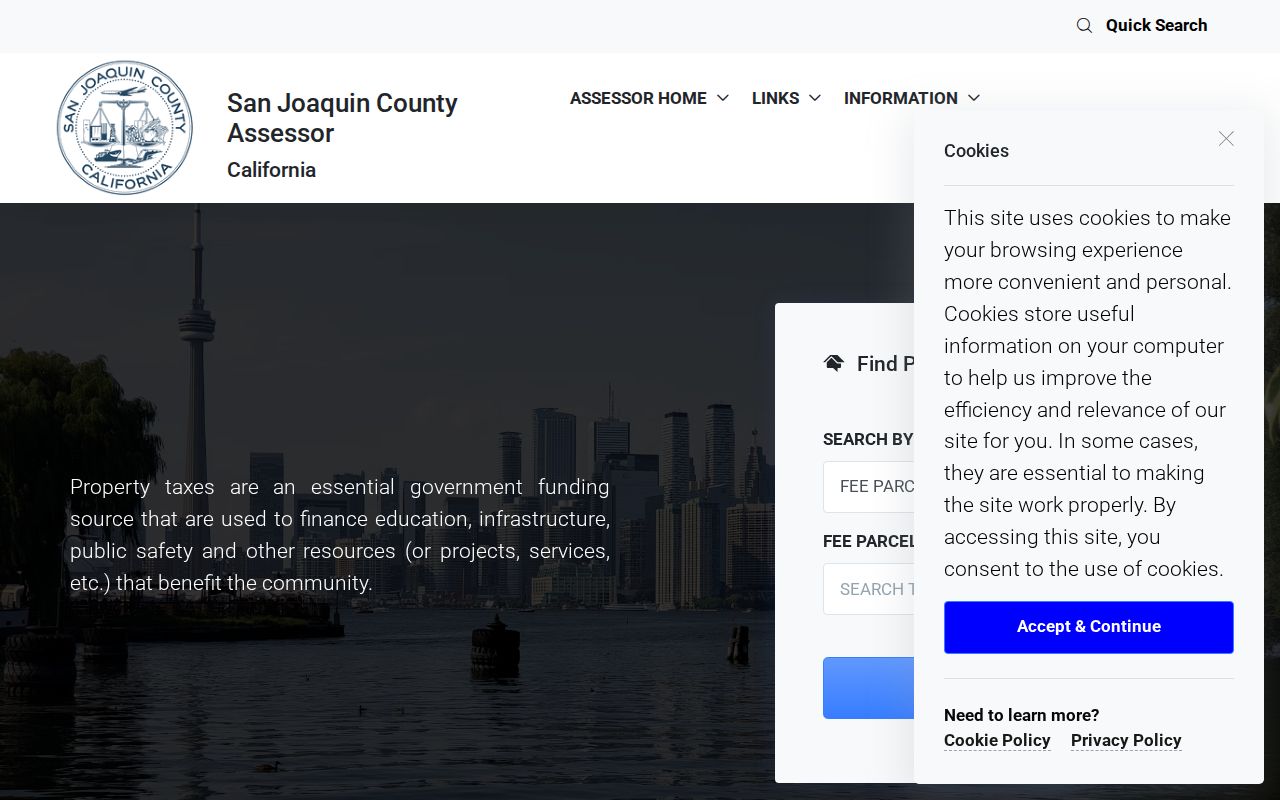
The tax search beside the map offers Assessment, Fee Parcel, and Street Address modes. It does not offer an owner-name or ZIP mode. Street syntax omits the suffix and abbreviates directions, so a full mailing label may fail until it is simplified.
[RESEARCH GAP: The manifest did not produce a successful full GIS parcel-viewer screenshot; inspect the live District Viewer for the current map state.]
- APN
- The assessor’s parcel number, which carries the property trail even when a street label changes.
- Plat
- A recorded map that lays out lots, blocks, streets, and subdivision relationships.
- Criss-cross directory
- A reverse address section that can point from a street address back to a name in a historical volume.
Tracy Mailing and Situs Addresses
A situs address says where land sits. A mailing address says where a tax notice or other county correspondence goes. The county sample secured bill includes Fee Parcel, Assessment, Owner, Tax Year, Location or situs, Bill Type, Tax Rate Area, values, exemptions, direct assessments, installment dates, and a total. The mailing route is the address in the recorded instrument or an alternate supplied to the Assessor.
Do not treat the two fields as a household match. An owner can receive a bill at another city. A renter can live at the situs without appearing on the owner roll. A trust, entity, or service address can also sit between a person and the physical parcel. If a Fee Parcel result concerns an unsecured bill or the assessee is unclear, the county lists (209) 468-2133 and tax@sjgov.org for clarification.
Address check. Keep three labels separate in notes: situs, mailing, and legal description. They may all point to the same land, but they do not identify the same relationship.
The homeowner exemption declares principal occupancy under penalty of perjury, yet it does not name every person in the home. It is evidence about a tax claim, not a complete Tracy street directory.
Tracy Deed Chain by Address
The recorder’s name index is a card-catalog guide to an instrument. Accept the disclaimer and press “I Accept” at the county’s official-record portal when the gate permits access. The online grantor and grantee index begins January 1, 1968 and reaches the present. Recorded material goes back to 1851, with pre-1968 digital or film access at the office.
For a street address, start with the newest deed or current owner source, then search that owner as grantee. The acquisition deed supplies the prior grantor. Search the grantor as an earlier grantee and repeat. Check spouses, trusts, entities, spelling variants, the APN, and the legal description. A Deed of Trust is financing, not a title transfer. A reconveyance is loan payoff, not a new owner.
- Keep the APN and exact legal description from the newest instrument.
- Record document number, recording date, party roles, and any referenced prior instrument.
- Move backward from grantee to grantor, testing the same APN and parcel map each time.
- Use liens and releases as related events, not as proof of a sale.
- Switch to the Stockton counter’s older deed books when the online year limit ends.
The San Joaquin Recorder index gateway is the source for the party and date step in a Tracy deed chain.
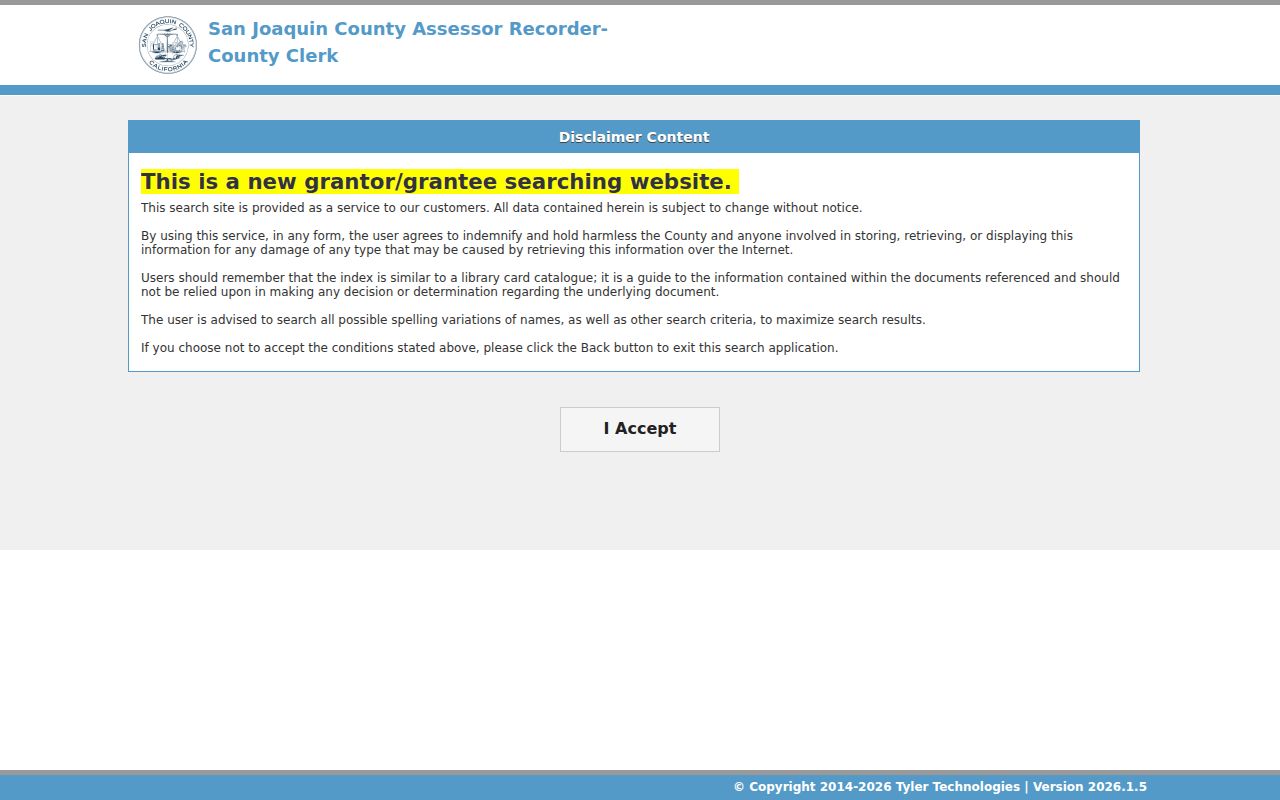
Online record pointers may be corrected daily and can contain same-name matches. The research notes document numbers from 2000 as YYYY-###### and earlier numbers as YY######. Underlying instruments decide the result.
Tracy Permit Address Evidence
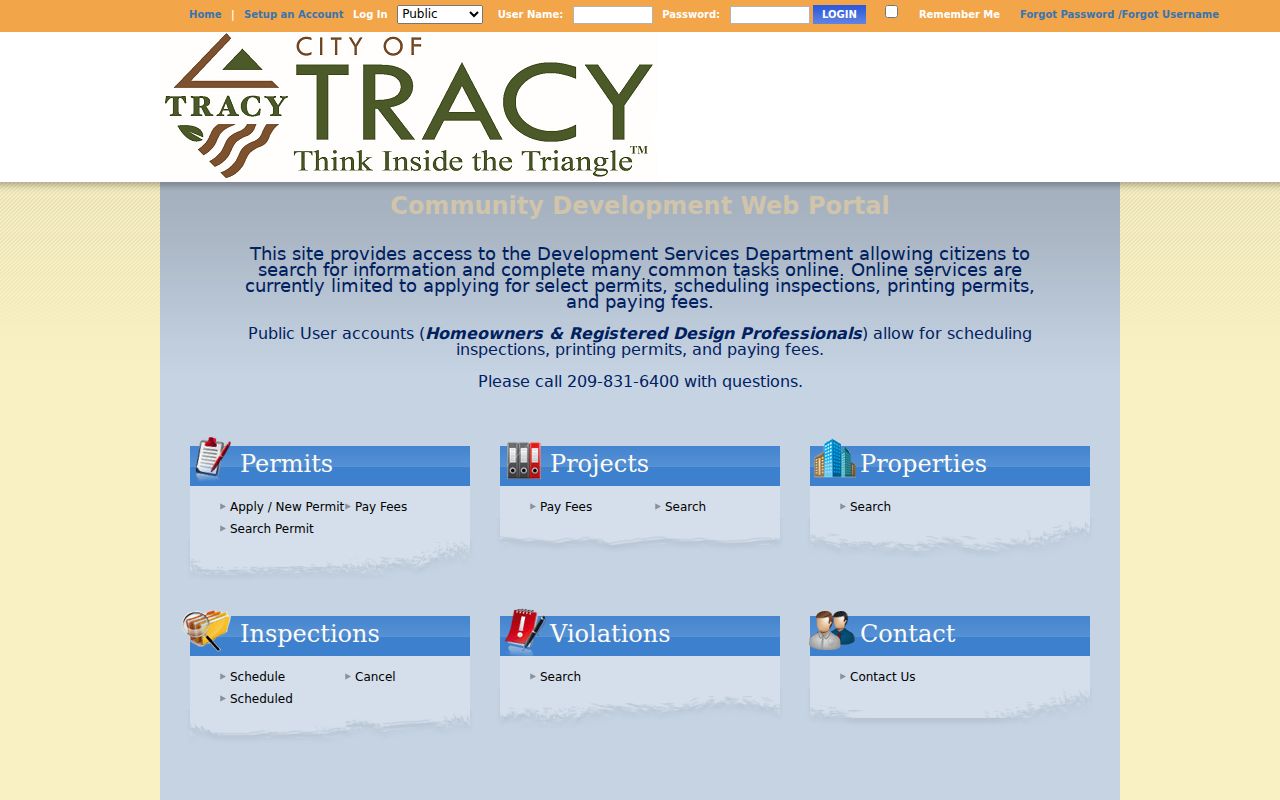
Tracy eTRAKiT connects an address to permits, projects, inspections, and violations when a user can reach the authorized search. Its menu advertises Apply or New Permit, Pay Fees, Search Permit, Search Projects, Search Property, Schedule, Cancel, Scheduled inspections, and Violations Search. Reviews can lead to More Info, Permit Info, and attachments.
During the August 16, 2026 inspection, direct Permit, Property, and Violation links redirected to login. Public-user registration is described for homeowners. Design professionals use registered accounts, and contractors must submit documentation to the Building Division. Development Services and Building Safety list (209) 831-6400, and plancheck@cityoftracy.org is listed for plan-check contact.
The Tracy eTRAKiT gateway shows the current address-record access condition.
A permit applicant or contractor is not automatically an owner or resident. Use an attachment, date, APN, or matching city request to make the address clue precise.
Tracy Code Files and CPRA
Code cases can add a useful address trail, but open investigations, victim details, and confidential information may be withheld. Tracy Code Enforcement lists (209) 831-6401 and a 24-hour hotline at (209) 831-6410. Police and other department records should go to the department or City Clerk rather than to a general search box.
Use NextRequest to search released material before filing. A focused request should name the street number, street name, record type, department, and date range. The California Public Records Act, Government Code sections 7920.000 and following, calls for an agency determination within ten days and permits a written fourteen-day extension in unusual circumstances. It does not require the city to build a resident list from separate files.
Paper copies cost $0.15 per page unless another law sets a different rate, and a CD recording is listed at $5. Inspection is ordinarily free. A request for a permit history or a dated code notice is more useful than a request for all records about a person.
Tracy Voter Walking Lists
San Joaquin’s voter application confirms that approved walking lists can be ordered by precinct, street name, and house number. It also explains why those lists do not belong in an open street directory. An applicant must choose Election, Political, Scholarly, Journalistic, Record Review, or Vendor, provide a photo ID and original wet signature, explain security, and submit by mail or in person.
The form allows a specific-voter request for up to ten people and quotes seven to fourteen business days. The county lists a $68 countywide file fee in the inspected 2025-26 form. Unauthorized sharing, marketing, public posting, harassment, and insecure storage are barred. California My Voter Status remains a self-service check for the authenticated voter.
This is a useful boundary lesson. An address-ordered record can exist without being a public resident list. A street directory should describe the access rule and the record’s scope, not recreate restricted voter data.
Tracy Reverse Directories by Street
For an older Tracy address, a reverse or criss-cross section may connect the street to an occupant name. Exact reverse-directory years and the final printed volume were not exposed by the public catalog, so ask the Tracy Branch librarian rather than assume a full run. The library policy confirms that city and telephone directories, yearbooks, local organization reports, newspapers, maps, and family histories belong to the local-history collection category.
Tracy Press microfilm runs from 1909 to the present. Polk city-directory volumes are confirmed for selected years between 1936 and 1981. Use a street name, house number, spelling variant, and nearby household as search terms. Then check a deed for title and a census or newspaper for occupancy. The result is historical context, not a current address assertion.
Tracy Street Geography
Tracy’s address geography crosses city limits, sphere of influence, postal city, ZIP, subdivision, and annexation lines. The city publishes separate Address Point, Street Centerlines, City Limit, Annexation, Sphere of Influence, ZIP, and parcel layers. The county GIS snapshot dated July 6, 2026 also includes districts, plans, hazards, and census geography.
A verified wholesale street-renumbering year was not found. Do not invent one. When a historic address appears to dead-end, test old place labels such as Ellis, Lathrop, Tulare Township, Tesla, and Corral Hollow, then compare Sanborn maps, legal descriptions, and the APN history. A 2026 West Tracy proposal also shows how land in the sphere of influence can sit outside the city until annexation changes the custodian trail.
USPS verifies the mailing label. GIS verifies the parcel and civic layers. The recorder verifies the instrument. Those three checks prevent a postal Tracy address from being mistaken for an incorporated Tracy parcel.
Tracy Street Directory Limits
The public owner trail is not a household census. Renters, children, guests, non-owner household members, utilities, delivery records, and protected residents may not appear. Mailing fields can point away from the parcel. A historical directory may list a household that moved years ago.
Lawful personal use. Use address records for house history, family research, reconnecting, civic review, or personal safety awareness. California Penal Code section 646.9 and related harassment laws still apply. Do not use a Tracy street directory to stalk, threaten, intimidate, or harm anyone.
For a complete record trail, name the source and date in your notes. Preserve the distinction between owner, occupant, applicant, voter, and historical entry. That habit makes a street directory more accurate and keeps a public map from being treated as permission to expose private household details.